
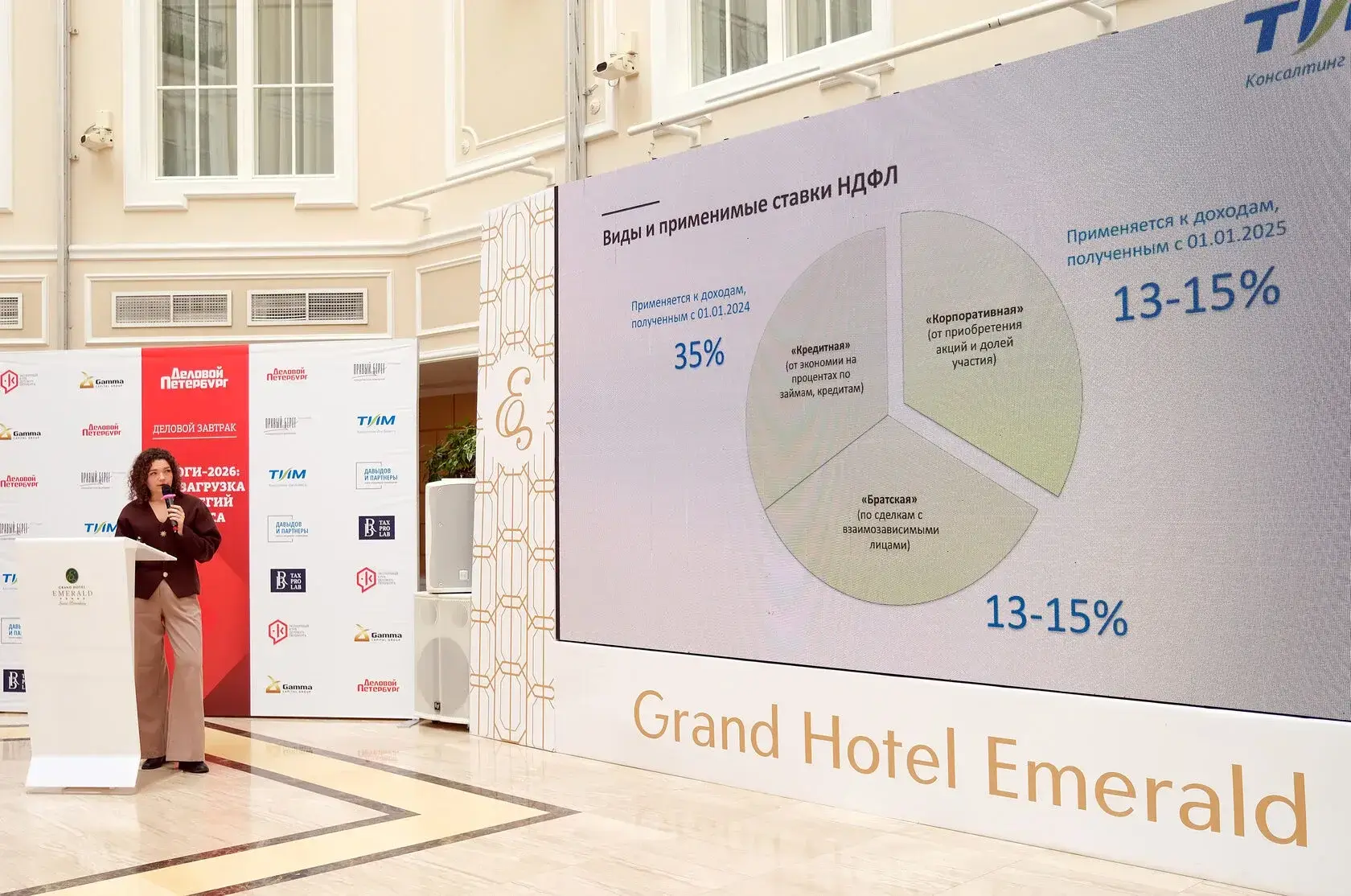
On March 12, the annual tax breakfast organized by Delovoy Petersburg took place at the Grand Hotel Emerald under the title “Taxes 2026: Business Strategy Reset.” Speakers and participants discussed the most pressing issues in business taxation.
For the second consecutive year, TEAM Senior Lawyer Yulia Dogadina was among the speakers, delivering a presentation titled “Material Benefit in 2026: Where to Find It and What to Do About It.”
Even in challenging conditions, there are tools and legal mechanisms that allow entrepreneurs to lawfully reduce tax burdens or protect assets from bankruptcy claims. However, new regulatory developments also bring additional risks that must be carefully considered.
One such nuance is the concept of material benefit. In essence, it is income received by an individual when goods, services, or financial assets are acquired on terms more favorable than market conditions. While it may sound like an advantage, in practice it often becomes a tax liability.
Entrepreneurs may encounter material benefit, for example, when a new investor enters a business or when ownership shares in a company are restructured. In such cases, it is essential to assess the implications in advance and incorporate them into the deal structure so that the “benefit” does not result in unexpected tax exposure.
As of January 1, 2025, income derived by individuals from such transactions — if they are not conducted on market terms — is subject to taxation. The tax base for share purchase transactions is calculated as the market value of the shares minus the actual costs of acquisition.
The market value of shares is determined proportionally based on the net asset value of the company as of the latest reporting date preceding the transaction. At the same time, structuring transactions at nominal share value, as was previously common, is no longer recommended due to significant tax risks.
Instead, Yulia Dogadina advises taking material benefit into account when planning the purchase or sale of shares.
“For example, if as of the latest reporting date — December 31, 2025 — the company’s net asset value is too high, but certain events later in the year may reduce it, it may be reasonable to postpone the transaction to a later period. This can help optimize costs and the overall tax burden of such deals,” notes Yulia Dogadina.
We have prepared a detailed algorithm for determining income in the form of material benefit in share transactions, available for download in our Telegram channel
For the second consecutive year, TEAM Senior Lawyer Yulia Dogadina was among the speakers, delivering a presentation titled “Material Benefit in 2026: Where to Find It and What to Do About It.”
Even in challenging conditions, there are tools and legal mechanisms that allow entrepreneurs to lawfully reduce tax burdens or protect assets from bankruptcy claims. However, new regulatory developments also bring additional risks that must be carefully considered.
One such nuance is the concept of material benefit. In essence, it is income received by an individual when goods, services, or financial assets are acquired on terms more favorable than market conditions. While it may sound like an advantage, in practice it often becomes a tax liability.
Entrepreneurs may encounter material benefit, for example, when a new investor enters a business or when ownership shares in a company are restructured. In such cases, it is essential to assess the implications in advance and incorporate them into the deal structure so that the “benefit” does not result in unexpected tax exposure.
As of January 1, 2025, income derived by individuals from such transactions — if they are not conducted on market terms — is subject to taxation. The tax base for share purchase transactions is calculated as the market value of the shares minus the actual costs of acquisition.
The market value of shares is determined proportionally based on the net asset value of the company as of the latest reporting date preceding the transaction. At the same time, structuring transactions at nominal share value, as was previously common, is no longer recommended due to significant tax risks.
Instead, Yulia Dogadina advises taking material benefit into account when planning the purchase or sale of shares.
“For example, if as of the latest reporting date — December 31, 2025 — the company’s net asset value is too high, but certain events later in the year may reduce it, it may be reasonable to postpone the transaction to a later period. This can help optimize costs and the overall tax burden of such deals,” notes Yulia Dogadina.
We have prepared a detailed algorithm for determining income in the form of material benefit in share transactions, available for download in our Telegram channel